Article: A Beginner’s Guide to Collecting Diecast Aircraft Models
A Beginner’s Guide to Collecting Diecast Aircraft Models

Diecast aircraft collecting brings together aviation history, detailed scale modelling and the enjoyment of building a display around the aircraft, eras and squadrons that interest you most.
However, starting a collection can initially feel confusing. New collectors may encounter unfamiliar scales, different manufacturers, limited-edition certificates, removable accessories and widely varying prices for models that appear quite similar.
This beginner’s guide explains how to start collecting diecast aircraft models, choose a suitable scale, understand the main manufacturers and inspect pre-owned aircraft before buying. It also covers condition, completeness, packaging, value and the safest ways to display and store a growing collection.
You can also browse currently available diecast aircraft models from Corgi Aviation Archive, Hobby Master and other established manufacturers.
What Is a Diecast Aircraft Model?
A diecast aircraft model is a ready-made representation of a real aircraft produced to a stated scale. The main body normally contains diecast metal, while smaller components such as undercarriage, weapons, aerials, propellers and cockpit details may be made from moulded plastic.
Unlike a traditional plastic model kit, a diecast aircraft is generally supplied painted, marked and assembled. Some parts may still need to be fitted by the collector, particularly removable landing gear, weapons, fuel tanks, display stands and aerials.
Diecast aircraft are primarily intended as collectable display models rather than toys. Their small projections, painted surfaces and removable components can be damaged through rough handling.
Why Do People Collect Diecast Aircraft?
Collectors are attracted to diecast aircraft for many different reasons. Some are interested in aviation history, while others concentrate on a particular aircraft, manufacturer, scale or military unit.
A collection might focus on:
- Second World War fighters and bombers
- Battle of Britain aircraft
- Cold War jets and interceptors
- Modern military aircraft
- Royal Air Force squadrons
- United States Air Force or Navy aircraft
- Aircraft connected with famous pilots
- Special or anniversary colour schemes
- One aircraft type, such as the Spitfire, Lancaster or F-14
- One manufacturer, such as Corgi Aviation Archive or Hobby Master
- One consistent scale
There is no requirement to follow a single theme. However, deciding what interests you most can make it easier to avoid buying models simply because they happen to be available.
Choose a Collecting Theme
A clear collecting theme can help control both cost and display space. It also gives the collection a stronger visual and historical connection.
For example, a collector interested in the Battle of Britain might concentrate on Spitfires, Hurricanes, Messerschmitt Bf 109s and supporting aircraft from 1940. Another collector might build a Cold War display containing Lightnings, Phantoms, Vulcans, MiGs and early American jets.
Possible approaches include collecting by:
- Historical period: First World War, Second World War, Cold War or modern aviation
- Aircraft role: fighters, bombers, transports, reconnaissance aircraft or helicopters
- Country or operator: RAF, Luftwaffe, USAAF, US Navy or another air arm
- Squadron: models representing one military unit through different periods
- Aircraft family: every available variant or scheme of a favourite aircraft
- Manufacturer: releases from one particular model brand
- Scale: models that display consistently alongside one another
Starting with a fairly focused theme does not prevent the collection from expanding later. It simply gives you a useful starting point.
Understanding Diecast Aircraft Scales
Scale describes the relationship between the size of the model and the real aircraft. A 1:72 scale model is 72 times smaller than the full-size aircraft, while a 1:48 model is 48 times smaller.
The smaller the second number, the larger the finished model. This means a 1:48 aircraft is larger than the same aircraft in 1:72 scale.
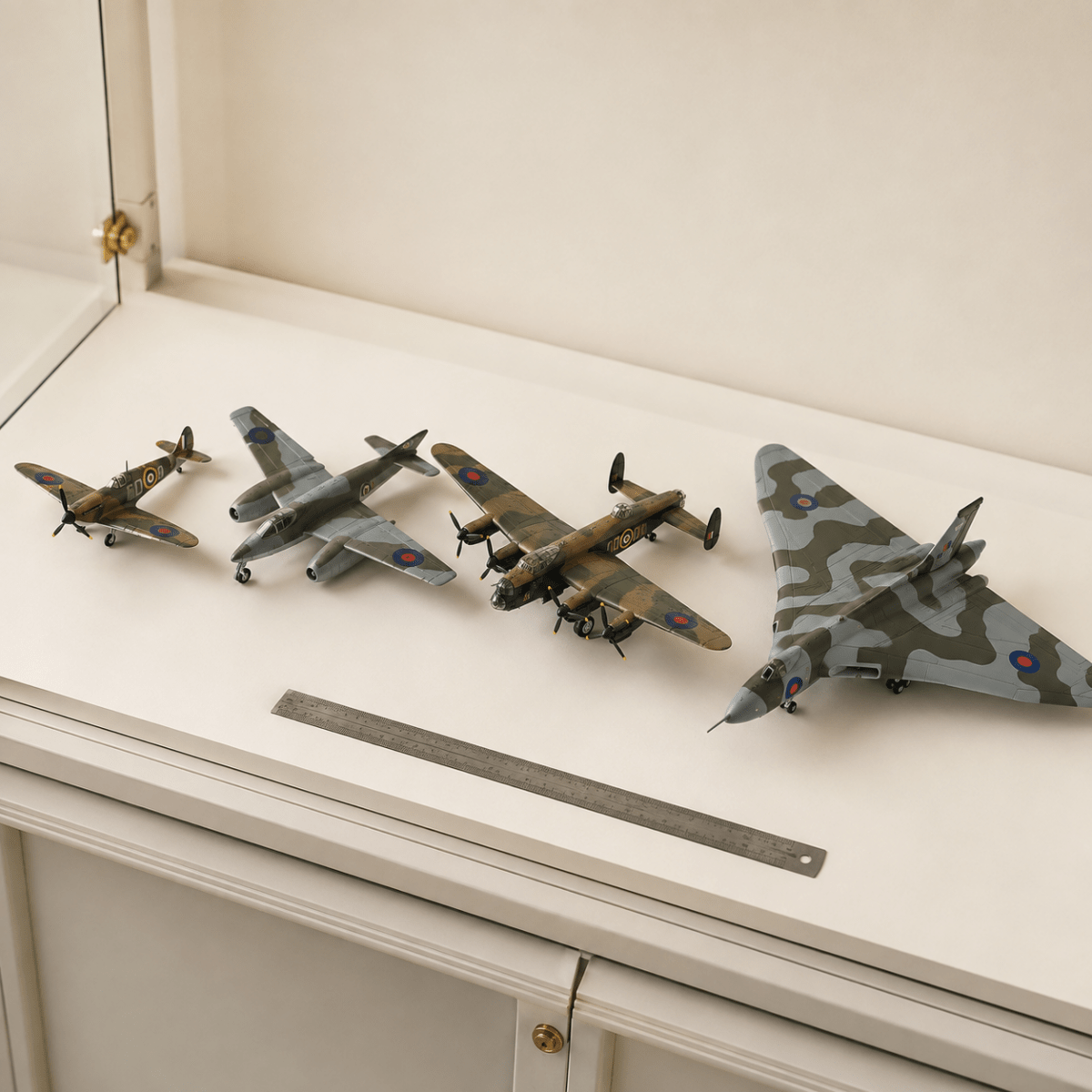
The actual size also depends on the real aircraft being represented. A 1:72 Avro Lancaster will require considerably more display space than a 1:72 Spitfire, even though both models share the same scale.
| Scale | Common uses | Display considerations |
|---|---|---|
| 1:400 | Commercial airliners and airport displays | Compact and suitable for larger fleets |
| 1:200 | Commercial aircraft and selected military subjects | More presence than 1:400 while remaining manageable |
| 1:144 | Large bombers, transports and compact military aircraft | Useful for aircraft that would be very large in 1:72 |
| 1:100 | Selected military and display aircraft | A middle ground between compact and larger scales |
| 1:72 | Military fighters, bombers, transports and helicopters | Wide choice with a good balance of size and detail |
| 1:48 | Detailed fighters, jets, helicopters and propeller aircraft | Larger display presence and greater cabinet depth required |
| 1:32 | Large centrepiece aircraft | Requires significant shelf or cabinet space |
Which Aircraft Scale Is Best for Beginners?
There is no single best scale, but 1:72 is often a practical starting point for military-aircraft collectors. It is widely represented by brands such as Corgi Aviation Archive and Hobby Master, and it offers a useful balance between visible detail and manageable display size.
Collectors who prefer larger individual display pieces may favour 1:48. The extra size can make cockpit details, markings, panel lines and weathering easier to appreciate, but fewer models will fit in the same cabinet.
Smaller scales such as 1:144, 1:200 and 1:400 work particularly well for large aircraft, commercial airliners or collectors who want to display a greater number of models.
Before choosing a scale, measure the shelf or cabinet where the collection will be displayed. Remember to consider both wingspan and model depth, including the additional space required by a display stand.
For more information about how different sizes have appeared within one of the best-known ranges, read our history of Corgi Aviation Archive scale sizes.
Choosing a Diecast Aircraft Brand
Different manufacturers have their own strengths, aircraft selections, production styles and accessory systems. The right brand will depend on the aircraft, periods and level of detail you prefer.
Corgi Aviation Archive
Corgi Aviation Archive is strongly associated with historic military aircraft, particularly RAF subjects, Second World War fighters and bombers, Cold War aircraft and British aviation history.
Many releases have a traditional diecast feel and may include display stands, removable undercarriage, historical information and numbered certificates. The exact contents vary between releases.
Our Corgi Aviation Archive collector’s guide explains the range, common scales and types of aircraft in more detail.
Hobby Master
Hobby Master aircraft are particularly well known for military jets, detailed surface finishes, interchangeable display parts and a broad range of international operators and colour schemes.
The Air Power Series contains many 1:72 releases, along with selected larger-scale aircraft. Models may include separate landing gear, closed gear doors, weapons, fuel tanks and stand components.
Read our introduction to Hobby Master diecast aircraft for more information about its main aircraft ranges.
Other Diecast Aircraft Manufacturers
The wider hobby includes manufacturers such as Century Wings, Gemini Aces, Gemini Jets, JC Wings, Dragon Wings, Franklin Mint, Witty Wings and others.
Some specialise in military aircraft, while others concentrate on commercial aviation or particular scales. Availability can vary because many releases are produced for a limited period and later become obtainable only through the second-hand market.
You can explore our other diecast aircraft brands or read our guide to manufacturers beyond Corgi and Hobby Master.
Corgi or Hobby Master?
Neither manufacturer is automatically better. Corgi may appeal more strongly to collectors of historic British aircraft, traditional diecast models and larger Second World War bombers. Hobby Master is particularly strong in modern jets, international military schemes and detailed interchangeable configurations.
Our full Corgi Aviation versus Hobby Master comparison covers the differences in aircraft choice, detail, packaging, accessories and display style.
Should You Buy New or Pre-Owned Models?
New models provide the reassurance that the aircraft and accessories have not passed through another collection. However, a newly boxed model should still be inspected carefully. Factory imperfections, loose parts and packaging contact can sometimes be present from the beginning.
Pre-owned models provide access to retired releases that are no longer available through normal retail channels. They can also offer good value when minor box wear or a small model imperfection has been described accurately.
When buying pre-owned, pay particular attention to:
- The exact manufacturer and product code
- Model condition
- Box and internal packaging condition
- Missing or replaced accessories
- Previous repairs
- Paint wear or rubbing
- Completeness of the stand
- Certificates, instructions and collector cards
- Whether the model matches the box
Clear photographs and a detailed condition description are especially important when buying online.
How to Inspect a Pre-Owned Diecast Aircraft
Do not judge a model only from a single photograph taken from above. Many common problems appear around the underside, wing edges, undercarriage and removable components.
Inspect or request photographs of:
- The nose and propeller
- Wing leading and trailing edges
- Wing tips
- Tailplanes and stabilisers
- Canopy and cockpit
- Undercarriage legs and wheels
- Missiles, pylons and fuel tanks
- Aerials, antennas and pitot tubes
- The underside of the aircraft
- The display stand and adaptor
- The outer box and internal packaging
Look for paint chips, rubbing, scratches, glue residue, leaning wheels, broken mounting pegs and components sitting at an unusual angle.
A minor imperfection does not necessarily make a model undesirable. What matters is that its condition is understood, photographed and reflected appropriately in the description and price.
Our condition grading system explains how models and boxes are assessed separately from Mint through to Fair condition.
Check Whether the Aircraft Is Complete
Completeness is separate from condition. An aircraft may have excellent paintwork while still being incomplete because its stand, weapons, undercarriage or certificate is missing.
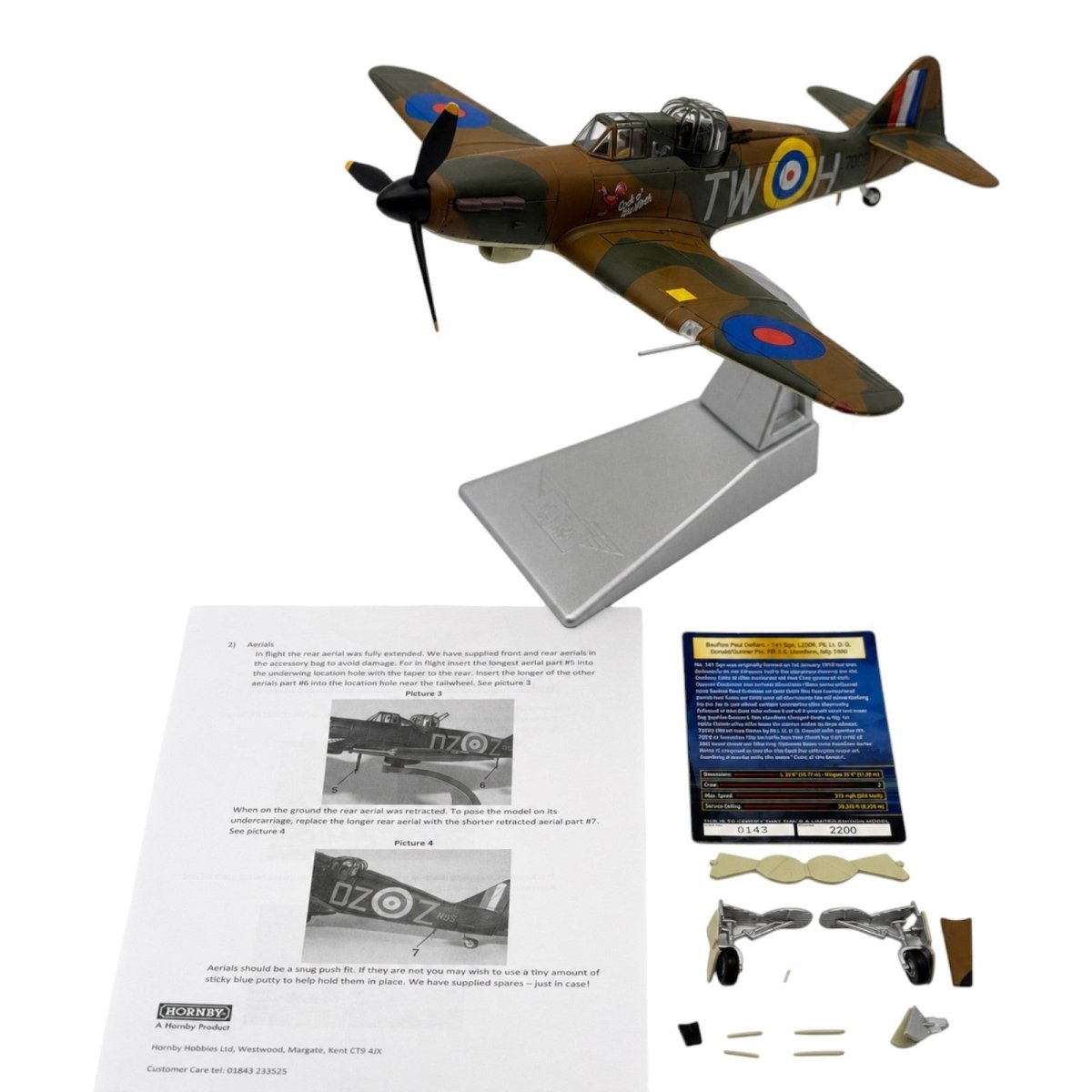
Depending on the exact release, the original contents may include:
- Display stand and support arm
- Aircraft-specific stand adaptor
- Landing gear and wheels
- Open and closed undercarriage doors
- Missiles, bombs or fuel tanks
- Alternative weapon arrangements
- Pilots or crew figures
- Aerials and pitot tubes
- Propellers or rotor components
- Fixing screws
- Instructions
- Certificate or collector card
Search using the exact product code rather than only the aircraft name. Two releases using the same basic tooling may have different accessories, stands and display arrangements.
Our detailed guide explains how to check whether a pre-owned diecast aircraft is complete.
Why the Original Box Matters
The original packaging protects the model, identifies the exact release and provides storage for removable accessories and paperwork.
A model does not need a perfect box to remain collectable, but packaging condition can influence desirability. Check for:
- Edge and corner wear
- Creases or crushed sections
- Tears and punctures
- Fading or water damage
- Missing polystyrene or plastic trays
- Broken internal supports
- Tape, labels or adhesive residue
- Damage around opening flaps
Confirm that the product code on the box matches the aircraft. A similar box may protect a model adequately, but it should not be described as the original packaging when the references do not correspond.
Do Certificates and Limited Editions Matter?
Some diecast aircraft releases include a numbered certificate, historical information card or collector booklet. These items form part of the model’s original presentation and can be important to collectors seeking a complete example.
However, a low certificate number does not automatically make a model rare or especially valuable. Collector demand, production quantity, availability, condition and completeness are generally more meaningful than the individual number alone.
Not every limited production model has an individually numbered certificate. Hobby Master aircraft, for example, are commonly produced in finite quantities without following the same certificate system associated with many Corgi releases.
Our guide to limited-edition aircraft, certificates and production numbers explains these differences in more detail.
What Makes a Diecast Aircraft Valuable?
Scale and age alone do not determine value. Two models of the same aircraft may sell for very different amounts because they represent different releases, manufacturers, markings or production quantities.
Factors that may influence value include:
- Manufacturer and product range
- Exact aircraft variant
- Squadron, pilot or historical connection
- Collector demand
- Availability on the second-hand market
- Model condition
- Box condition
- Completeness
- Previous repairs or replacement parts
- Original certificate and paperwork
- Recent comparable sold prices
Limited edition wording should not be treated as a guarantee of rarity or future value. A large production run may remain easily available, while a less heavily promoted release can become difficult to find because demand exceeds the number reaching the market.
For help identifying and researching a model, read our guide answering how much a diecast aircraft model may be worth.
How to Display Diecast Aircraft Safely
A display cabinet provides useful protection from dust, accidental handling and falling objects. It should be positioned away from direct sunlight, radiators, damp walls and areas where it may be knocked.
Before placing a model in a cabinet:
- Check that the shelf can support the combined weight
- Make sure the display stand is correct for the aircraft
- Confirm that all stand fittings are secure
- Do not force an adaptor into the model
- Check that fitted undercarriage is properly aligned
- Leave sufficient space between wings and neighbouring models
- Keep boxes and paperwork away from direct sunlight
A collection does not need to contain as many models as possible. Leaving space around each aircraft often creates a more attractive display and reduces the risk of damage when one model is removed.
Cleaning and Caring for a Collection
Diecast aircraft require less cleaning when they are displayed in an enclosed cabinet. When dust does accumulate, use a clean and very soft brush with minimal pressure.
Avoid lifting the model by its wings, propeller, canopy, undercarriage or weapons. Support a strong central section of the fuselage and use both hands for larger aircraft.
Household cleaning sprays, solvents, wet wipes and metal polish should not be used on collectable models. These products may affect paint, decals, clear canopies or printed markings.
Read our full guide to cleaning, storing and displaying diecast aircraft models for more detailed advice.
Common Problems to Watch For
Even a model that has remained inside its box can develop problems through age, factory assembly or contact with internal packaging.
Common issues include:
- Paint rubbing against plastic trays
- Chips along wing edges and tips
- Detached aerials or weapons
- Broken undercarriage pegs
- Loose canopies
- Glue residue from previous repairs
- Yellowed clear plastic
- Damaged internal packaging
- Paint cracking or bubbling
- More serious deterioration of the metal casting
Do not immediately attempt a repair. An unsuitable glue, mismatched paint or misaligned component can make a small problem considerably worse.
Our guide to common diecast aircraft damage, repairs and zinc rot explains what to examine before taking action.
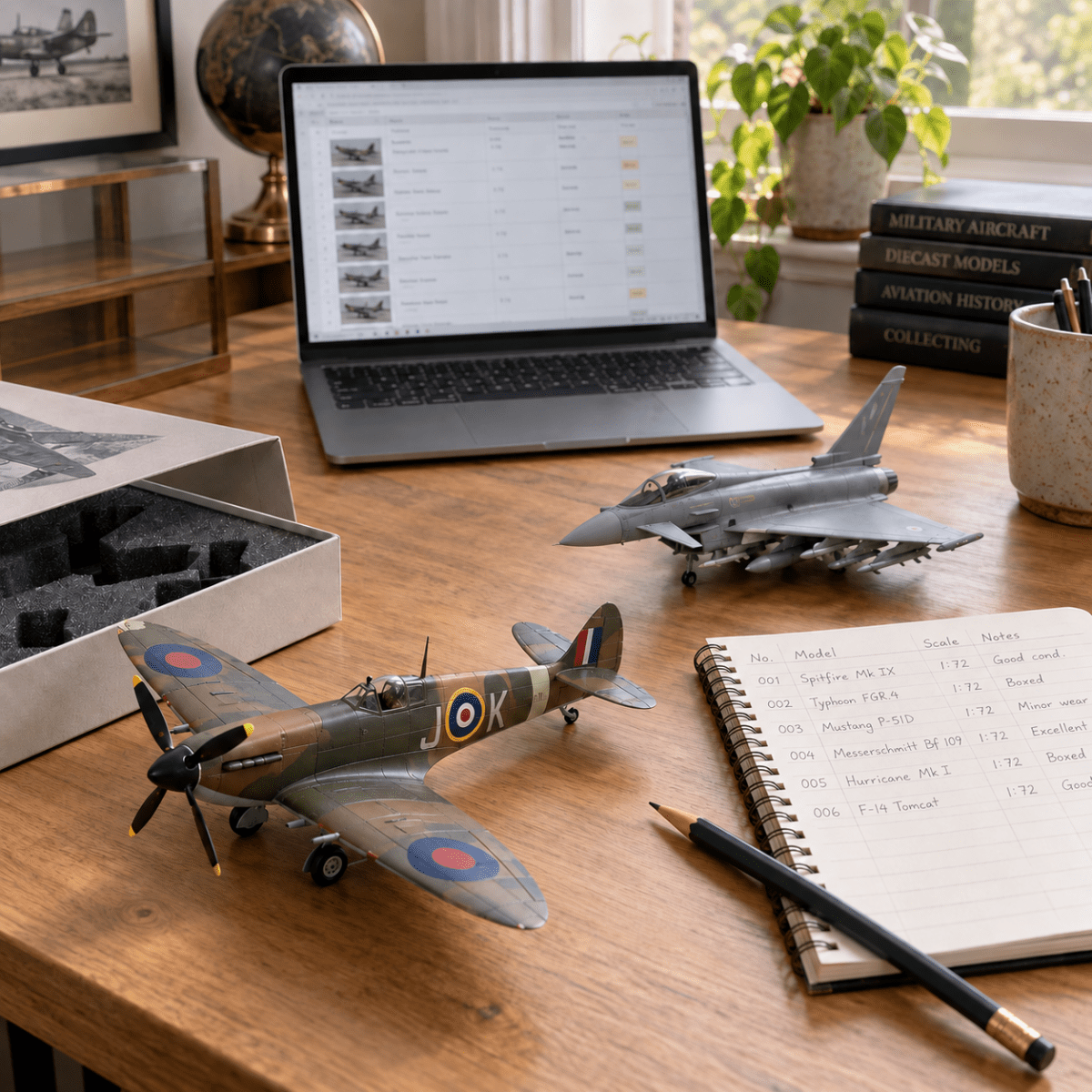
Keep a Record of Your Collection
A simple collection record becomes increasingly useful as the number of models grows.
Record information such as:
- Manufacturer
- Product code
- Aircraft and variant
- Scale
- Squadron and serial number
- Date purchased
- Purchase price
- Model condition
- Box condition
- Included accessories
- Certificate number where applicable
- Storage or display location
Photographs can also help document the model’s condition and identify which loose accessories belong with each release.
Common Beginner Mistakes
Buying Without Measuring the Display Space
A large bomber or transport aircraft can occupy considerably more room than expected. Check the model’s stated dimensions before buying, particularly in 1:72, 1:48 or 1:32 scale.
Assuming Every Model Is Complete
A model may look complete in photographs while alternative landing gear, weapons, doors or the correct stand adaptor remain missing.
Forcing Removable Parts Into Place
Weapons, landing gear and stand adaptors may look similar between releases but use different locating pins. Stop if a component does not fit naturally.
Buying Every Available Model
It is easy to expand too quickly when beginning a collection. A defined theme, scale or budget can help keep the collection manageable and personally meaningful.
Discarding Boxes or Unused Accessories
Original packaging, alternative display parts, certificates and instructions may be important later, even when they are not used in the current display.
Beginner’s Diecast Aircraft Buying Checklist
Before purchasing a model, confirm:
- The manufacturer
- The exact product code
- The aircraft and variant
- The scale and finished dimensions
- The model’s condition
- The condition of the box and internal packaging
- Whether all accessories are included
- Whether any part has been repaired or replaced
- Whether the stand and adaptor are correct
- Whether the model matches its box and certificate
- Whether the price is reasonable compared with similar sold examples
- Whether you have somewhere safe to display or store it
Frequently Asked Questions
What is the best diecast aircraft scale to collect?
The best scale depends on your display space and preferred aircraft. Many military-aircraft collectors choose 1:72 because it combines good detail with a broad choice of releases. Larger 1:48 models provide more presence, while smaller scales are useful for large aircraft and compact displays.
Which diecast aircraft brand is best for beginners?
Corgi Aviation Archive and Hobby Master both offer strong starting points. Corgi is particularly suited to historic British and Second World War subjects, while Hobby Master offers an extensive choice of military jets and international schemes. The best brand is the one producing the aircraft and periods that interest you.
Are pre-owned diecast aircraft worth buying?
Yes. The pre-owned market provides access to retired and difficult-to-find releases. Check the model’s condition, completeness, packaging and any previous repairs before buying.
Do diecast aircraft models increase in value?
Some retired models become more desirable, but an increase is not guaranteed. Demand, scarcity, condition, completeness and historical interest all influence value. Models are best purchased primarily because you want to own and display them.
Should diecast aircraft be kept in their boxes?
Models can be displayed safely in a suitable cabinet, but the original box, internal packaging, accessories and paperwork should still be retained. They protect the model during storage or transport and help identify the exact release.
Can different aircraft scales be displayed together?
Yes. Some collectors prefer a uniform scale, while others organise displays by aircraft type, era or manufacturer. Mixing scales is a matter of personal preference, although matching scales can make size comparisons more visually consistent.
Final Thoughts
A successful diecast aircraft collection does not need to be large or expensive. Begin with an aircraft, historical period or manufacturer that genuinely interests you, then choose a scale that fits your available display space.
Research the exact product code, examine condition carefully and check that removable accessories, packaging and paperwork are present. Taking these steps makes it easier to buy confidently and build a collection that remains enjoyable rather than becoming difficult to manage.
At The Collectables Vault, pre-owned aircraft are individually inspected, graded and photographed. Known damage, repairs and missing components are described so collectors can understand the exact model they are purchasing.
You can browse all currently available diecast aircraft, explore our previously sold model archive or discover more information through our collector guides and articles.

Written by Jay Sawyer