How Much Is My Diecast Aircraft Model Worth? Identification & Value Guide
Diecast aircraft models can range from inexpensive display pieces to highly sought-after collectables, but identifying a model’s true value is not always straightforward. Two models of the same aircraft and scale may have very different values because of their manufacturer, markings, condition, packaging and availability.
Whether you have inherited a collection, rediscovered an old model or are considering buying a pre-owned example, this guide explains how to identify a diecast aircraft model and understand the factors that may influence its value.
For further advice on collectability and scarcity, you may also find our guide to spotting rare diecast aircraft models useful.
Start With the Manufacturer
The first step is identifying who produced the model. The manufacturer’s name or logo will often appear on the underside of the aircraft, its display stand or the original packaging.
Well-known diecast aircraft manufacturers include:
- Corgi Aviation Archive
- Hobby Master
- Century Wings
- Gemini Aces
- Gemini Jets
- JC Wings
- Dragon Wings
- Franklin Mint
- Witty Wings
- Calibre Wings
Many of these manufacturers can also be explored through our other diecast aircraft brands collection.
The manufacturer matters because each brand has its own collector following, production standards and release history. A model produced by one brand may be more desirable than the same aircraft represented by another.
However, the manufacturer alone does not determine value. The aircraft, markings, production quantity, condition and level of collector demand must also be considered.

Original packaging can help identify the manufacturer, product series, scale, aircraft details and exact model code.
Find the Model Code
The model code is usually the most reliable way to identify a diecast aircraft model.
For example, Corgi Aviation Archive model codes commonly begin with letters such as AA, while Hobby Master aircraft references commonly begin with HA.
The model code may appear:
- On the end or underside of the box
- Near the barcode
- On a certificate
- In the instruction sheet
- On the display stand
- On the underside of the model
A code such as AA34018 or HA7801 identifies a particular release rather than simply an aircraft type. This is important because manufacturers frequently produce several versions of the same aircraft with different squadron markings, pilots, serial numbers and historical subjects.
Searching for the complete model code is normally much more accurate than using a broad description such as “Corgi Spitfire model”.
When checking a model code online, compare the photographs carefully. Incorrectly labelled listings, replacement boxes and mismatched accessories can occasionally lead to identification mistakes.

The product code is one of the most reliable ways to identify an exact release. Hobby Master aircraft codes usually begin with “HA”, followed by the individual release number, such as HA3871.
Check the Aircraft, Markings and Serial Number
Once you have found the manufacturer and model code, confirm that the aircraft and markings match the release you have identified.
Look for details including:
- Aircraft type and variant
- Squadron or military unit
- Registration or serial number
- Pilot or crew connection
- Country and operator
- Historical date or campaign
- Special or commemorative markings
Small differences can have a considerable effect on collector interest. A standard operational scheme may be relatively easy to find, while an aircraft associated with a famous pilot, anniversary, squadron or historic event may attract stronger demand.
The exact aircraft variant also matters. A Spitfire Mk.I, Mk.V, Mk.IX and Mk.XIV may appear broadly similar to a new collector, but they represent different aircraft variants and individual model releases.
Do not rely on the general aircraft name alone. The model code, serial number and markings should all correspond with the same release.

Corgi packaging can help confirm the brand, Aviation Archive series, scale, product code and the aircraft’s variant, pilot, location and historical period.
Confirm the Scale
Scale describes the relationship between the model and the real aircraft. Common diecast aircraft scales include:
- 1:32
- 1:48
- 1:72
- 1:100
- 1:144
- 1:200
A 1:72 model is 72 times smaller than the real aircraft, while a 1:48 model is larger and will usually require more display space.
Scale can influence value, but larger does not automatically mean more valuable. A rare or highly desirable 1:72 release may be worth considerably more than a commonly available 1:48 model.
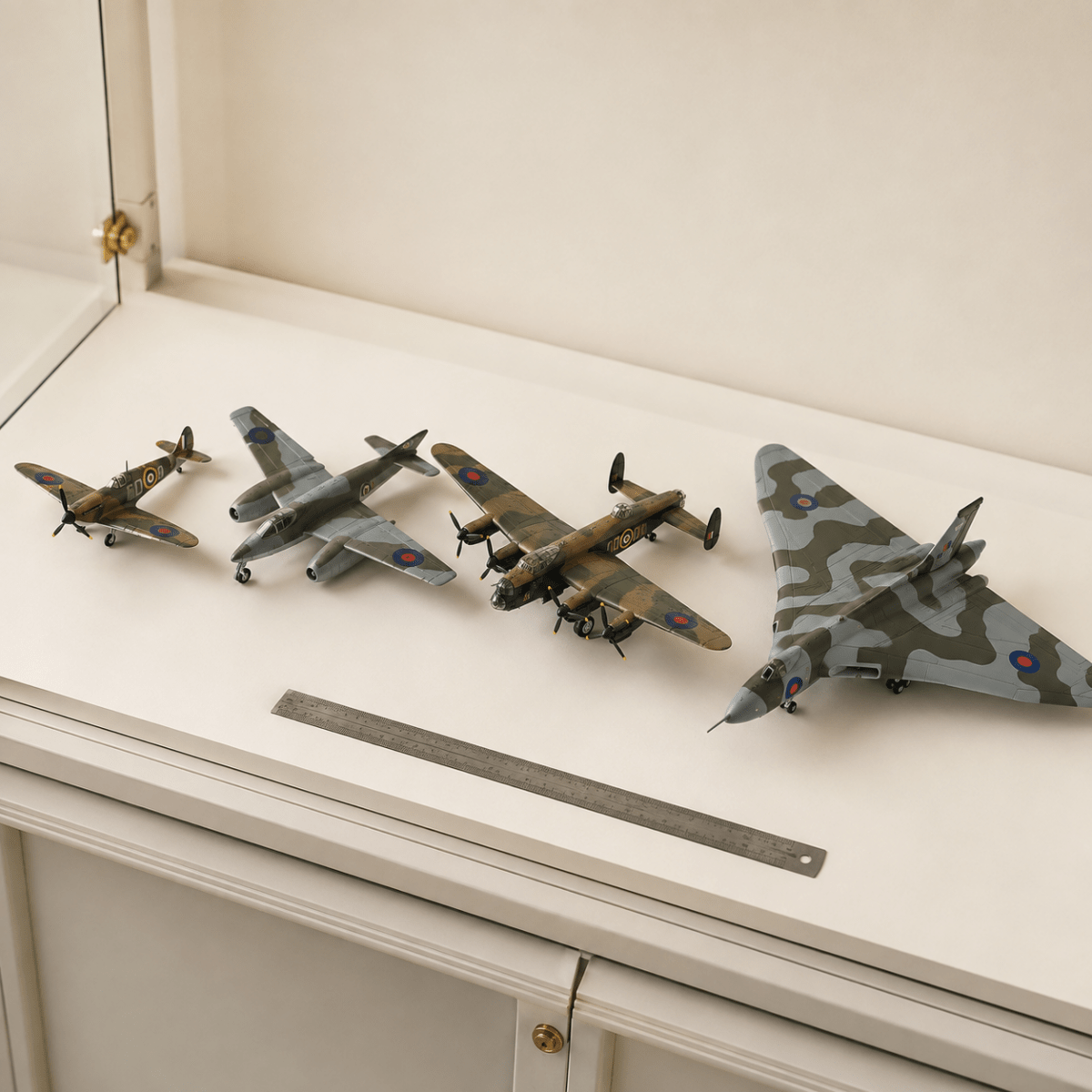
The aircraft itself also affects the finished dimensions. A 1:72 bomber will be much larger than a 1:72 single-engine fighter, despite both being produced to the same scale.
Collectors researching older Corgi releases can learn more in our history of Corgi Aviation Archive scale sizes, covering scales from 1:144 through to larger 1:32 display models.
Examine the Model’s Condition
Condition is one of the most important influences on the value and desirability of a pre-owned diecast aircraft model.
Check the model carefully for:
- Paint chips or rubbing
- Scratches and marks
- Paint bubbling or cracking
- Glue residue
- Detached or repaired parts
- Bent aerials, pitot tubes or undercarriage
- Missing missiles, bombs or fuel tanks
- Damaged propellers
- Broken hinges or moving components
- Yellowing or discolouration
A model does not need to be completely perfect to remain collectable. Minor marks may be acceptable on an older or difficult-to-find release, particularly when the model is complete and still displays well.
However, repairs should always be disclosed. A neatly repaired component may be preferable to a completely missing part, but it will usually affect value when compared with an untouched example in the same overall condition.
Condition should also be assessed realistically rather than judged only from a distance. Areas such as leading edges, propeller tips, undercarriage, pylons, aerials and the underside of the model can reveal damage that is not immediately visible when the aircraft is displayed.
For a more detailed explanation, read our collector’s guide to grading diecast aircraft models. You can also view the condition grading scale used by The Collectables Vault.

Paint wear along exposed areas such as wing leading edges can be easy to miss from a distance and may reduce a model’s condition grade and value.
Check Whether the Model Is Complete
Many diecast aircraft models include small removable accessories. These can easily become separated from the model over time, particularly when a collection has been displayed or moved between owners.
Depending on the release, the original contents may include:
- Display stand
- Undercarriage components
- Closed undercarriage doors
- Missiles, bombs or fuel tanks
- Alternative weapons
- Propellers
- Crew figures
- Nameplate
- Certificate
- Instruction sheet
- Collector card
- Fixing screws
- Protective packaging pieces
A missing stand or accessory may not prevent the aircraft from being displayed, but it can reduce its appeal to collectors looking for a complete example.
Replacement accessories can sometimes be found, although they may differ from the parts originally supplied with that particular release. A replacement stand, for example, may fit the model correctly without being the exact stand originally included in the box.
Completeness and model condition should normally be considered separately. An aircraft may have excellent paintwork but still be incomplete because a certificate, stand or optional accessory is missing.

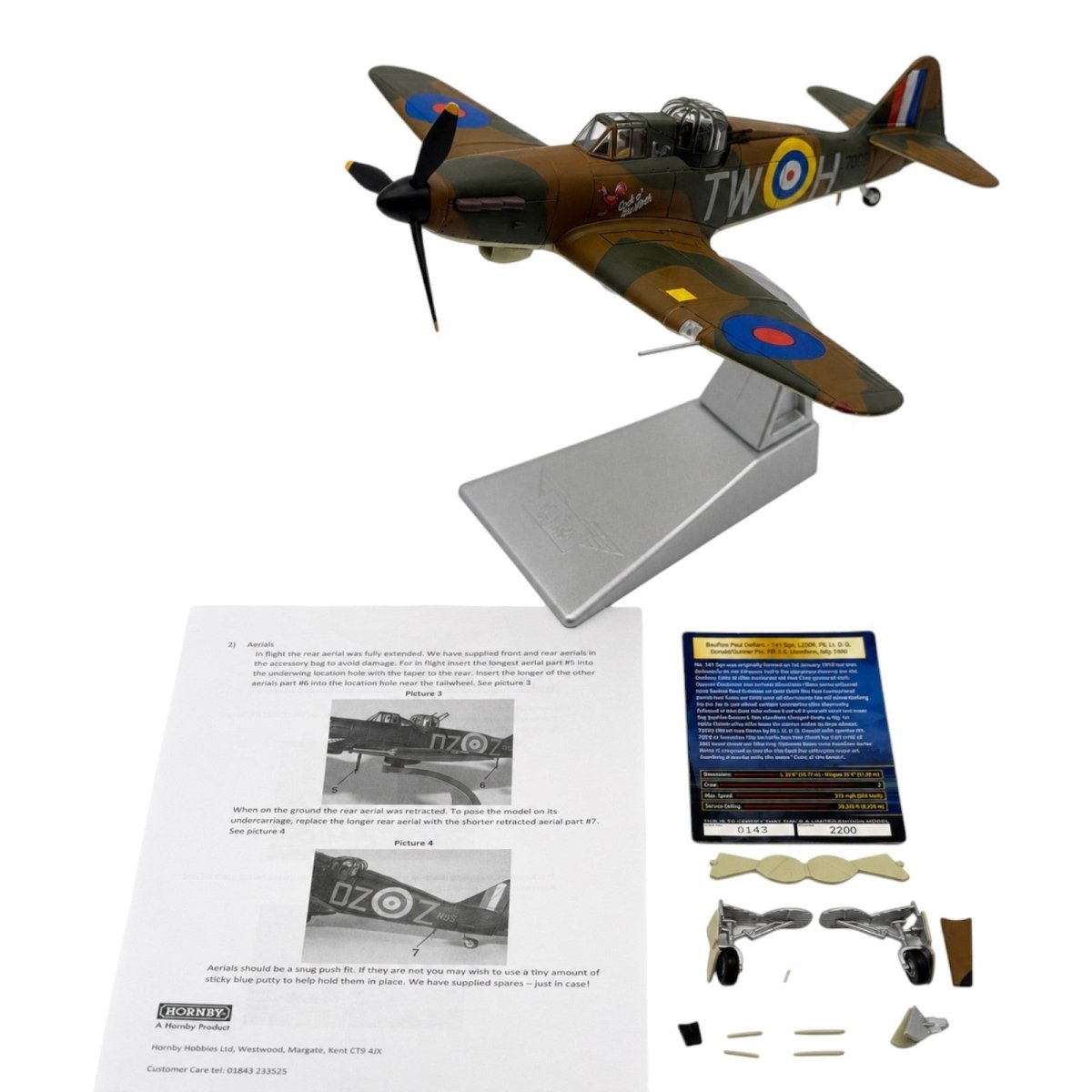
An example diecast aircraft accessory set containing undercarriage components, doors, a pilot figure and other removable parts. The contents supplied will vary between individual model releases.
Assess the Original Packaging
Original packaging is particularly important in the diecast collecting market. It protects the model, stores its accessories and helps confirm exactly which release it belongs to.
Examine the box for:
- Edge and corner wear
- Creases
- Tears or punctures
- Fading
- Water damage
- Crushed areas
- Missing internal packaging
- Damaged polystyrene or plastic trays
- Removed price labels
- Tape or sticker residue
A model with a worn box may still be desirable, particularly when the aircraft itself is in excellent condition. However, collectors will generally pay more for examples where both the model and its original packaging have been preserved well.
For some releases, the internal packaging is just as important as the outer box. Missing trays, fixing screws, foam sections or protective inserts can make the model more difficult to store and transport safely.
A box should also be checked against the model code and markings. A box from a similar release may provide useful protection, but it should not be described as the model’s original box when the references do not match.

Heavy wear to the box surface can cause the printed outer layer to break down and expose the cardboard beneath, reducing the overall packaging condition.
Does a Limited Edition Number Increase Value?
Many diecast aircraft models were marketed as limited editions and may include an individually numbered certificate.
A low certificate number can be appealing, but it does not automatically make the model significantly more valuable. The total production quantity, subject and level of collector demand are normally more important than the individual number printed on the certificate.
For example, model number 25 from a production run of 5,000 is still part of a relatively large release. Another model without an individually numbered certificate may be harder to find if fewer examples were produced or fewer remain available in good condition.
Collectors should therefore avoid judging rarity from the certificate number alone. The certificate is one part of the complete set, but it is not a guarantee that the model is valuable.

This Corgi certificate shows the individual edition number, 0207, and the total stated production run of 1300 models. A lower certificate number does not necessarily make a model more valuable.
Rare Does Not Always Mean Valuable
Rarity and value are connected, but they are not the same thing.
A model can be difficult to find because relatively few were produced, but its value may remain limited when few collectors are actively looking for it. Equally, a model produced in larger numbers may continue to command a strong price when it represents a popular aircraft, squadron, pilot or historical subject.
Demand may be influenced by:
- Famous aircraft types
- Popular squadrons
- Well-known pilots
- Historically important subjects
- Attractive or unusual liveries
- Models needed to complete a series
- Releases that were fragile or often damaged
- Models rarely offered in complete condition
The strongest values normally occur where limited availability is combined with sustained collector demand.
Age should not be confused with rarity either. An older model is not automatically rare, and a more recent model can become difficult to find when it sold out quickly or had a smaller production run.
Our guide explaining how to spot a rare diecast aircraft model explores these factors in greater detail.
Use Sold Prices, Not Asking Prices
Online asking prices can provide useful background, but they do not necessarily show what a model is worth.
A seller can advertise a model at almost any price, and an overpriced listing may remain unsold for months or even years. Completed and sold listings are usually more useful because they show what buyers have actually been prepared to pay.
When comparing sold examples, make sure they match as closely as possible in terms of:
- Manufacturer and model code
- Aircraft markings
- Model condition
- Completeness
- Box condition
- Country of sale
- Postage costs
- Date of sale
One unusually high or low result should not be treated as the definitive value. It is better to compare several relevant sales and establish a realistic range.
Older results may also be less useful because collector demand, availability and general market conditions can change over time.
You can browse our previously sold models archive to see examples of diecast aircraft and other collectables that have passed through The Collectables Vault. The archive is useful for identification and reference, although previous retail prices should not be treated as a guaranteed current valuation.
Be Careful With Unboxed or Misidentified Models
Unboxed models can be more difficult to identify because several releases may use the same basic aircraft casting.
Markings, serial numbers, paint schemes and weapons configurations become especially important when the original packaging is unavailable.
Common identification mistakes include:
- Confusing similar aircraft variants
- Using the wrong model code
- Matching the aircraft to the wrong box
- Assuming replacement accessories are original
- Describing a model as rare without checking availability
- Mistaking a customised model for a factory release
- Assuming every accessory found in the box belongs to that release
A mismatched box may still provide useful protection, but it should not be presented as the model’s original packaging.
Custom-painted or modified models can still have display appeal, but their value may differ considerably from an original factory-produced example. Signs of repainting can include inconsistent paint finishes, missing factory markings, overspray, non-standard decals or colours that do not match documented examples.
Consider Specialist Advice for Larger Collections
A single model can often be researched using its model code and recent comparable sales. Larger collections can be more complicated.
A collection may include a mixture of:
- Common releases
- Rare or discontinued models
- Damaged examples
- Missing accessories
- Different manufacturers and scales
- Boxed and unboxed models
- Models with uncertain identification
An experienced collector or specialist retailer may be able to help identify individual releases and provide a realistic assessment of the collection.
It is important to understand the difference between a potential retail value and a direct purchase offer. A retail value reflects what models might achieve when sold individually over time. A direct purchase offer will usually be lower because the buyer takes on the work and costs involved in inspecting, researching, photographing, storing, listing, packing and reselling each model.
Selling a complete collection directly can still be a practical option for someone who does not want to list, pack and post every model individually.
Looking to Sell a Diecast Aircraft Collection?
The Collectables Vault purchases selected individual diecast aircraft models and larger collections from manufacturers including Corgi Aviation Archive, Hobby Master, Century Wings, Gemini Aces, JC Wings, Dragon Wings, Franklin Mint and others.
Any offer will depend on the model’s identity, condition, completeness, packaging, current demand and the work required to prepare it for resale.
To help us understand what you have, provide clear photographs showing:
- The full collection or group of models
- The model codes on the boxes
- The aircraft and their markings
- Any visible damage or missing parts
- The general condition of the packaging
You can send the details through our contact page. Please include as much information as possible so the models can be assessed accurately.
A Quick Diecast Model Identification Checklist
Before attempting to identify or assess a diecast aircraft model, record the following:
- Manufacturer
- Model code
- Aircraft and variant
- Squadron or unit
- Serial number or registration
- Scale
- Model condition
- Box condition
- Missing or repaired parts
- Included accessories and paperwork
- Several recent comparable sold prices
Clear photographs of the model, underside, markings, accessories and packaging will make identification considerably easier.
Final Thoughts
The value of a diecast aircraft model cannot usually be determined from its size or age alone. Correct identification, condition, completeness, packaging, availability and collector demand all contribute to the final figure.
Begin with the manufacturer and model code, then compare the aircraft carefully with complete examples that have sold recently. Most importantly, assess the condition honestly. A clearly described model with well-photographed imperfections will generally inspire more confidence than one presented as perfect without sufficient detail.
Even when a model is not particularly rare, it may still have strong display appeal or an interesting historical connection. For many collectors, that is just as important as its financial value.
You can browse our current diecast aircraft model collection, explore the previously sold archive, or discover more articles through our collector guides and histories.

Written by Jay Sawyer