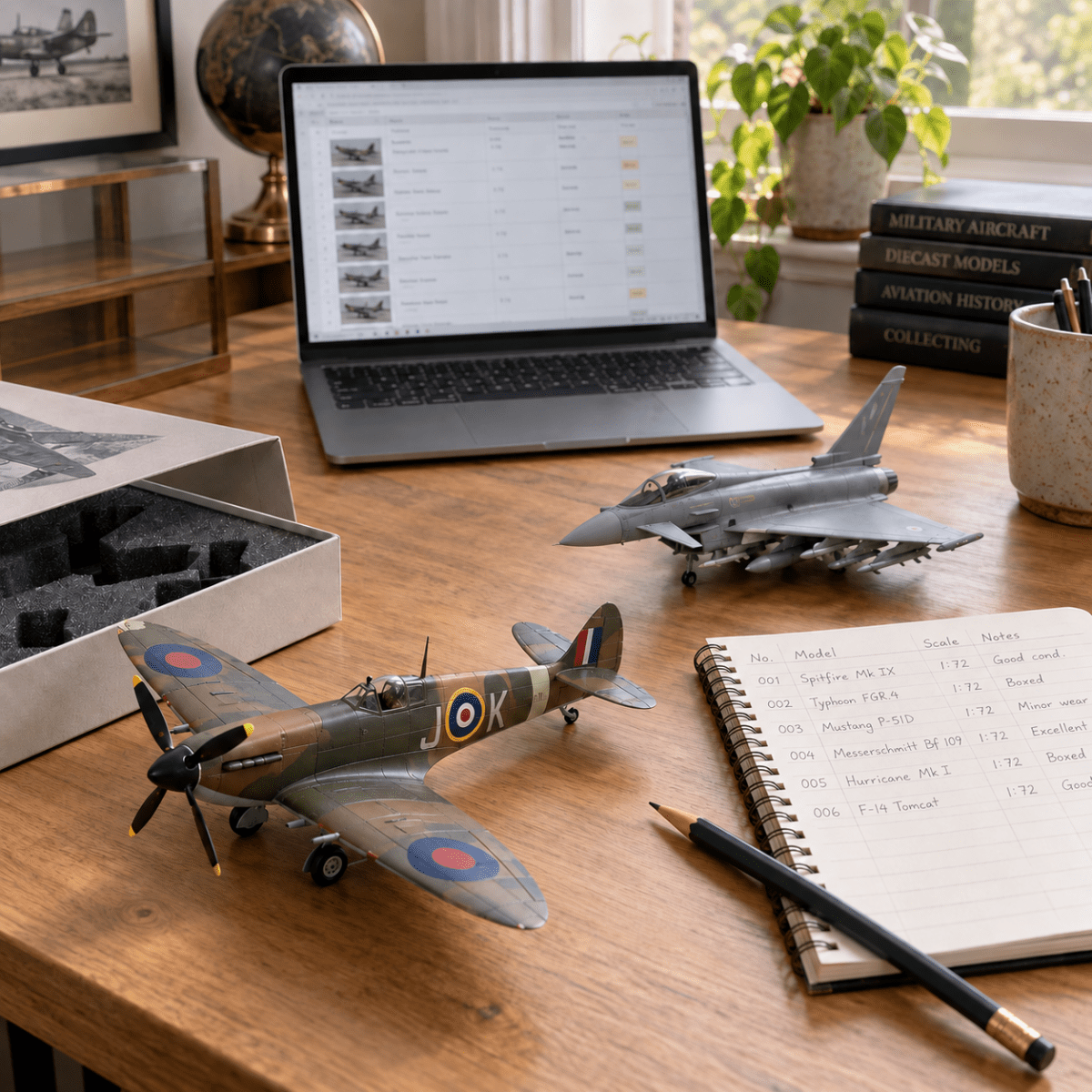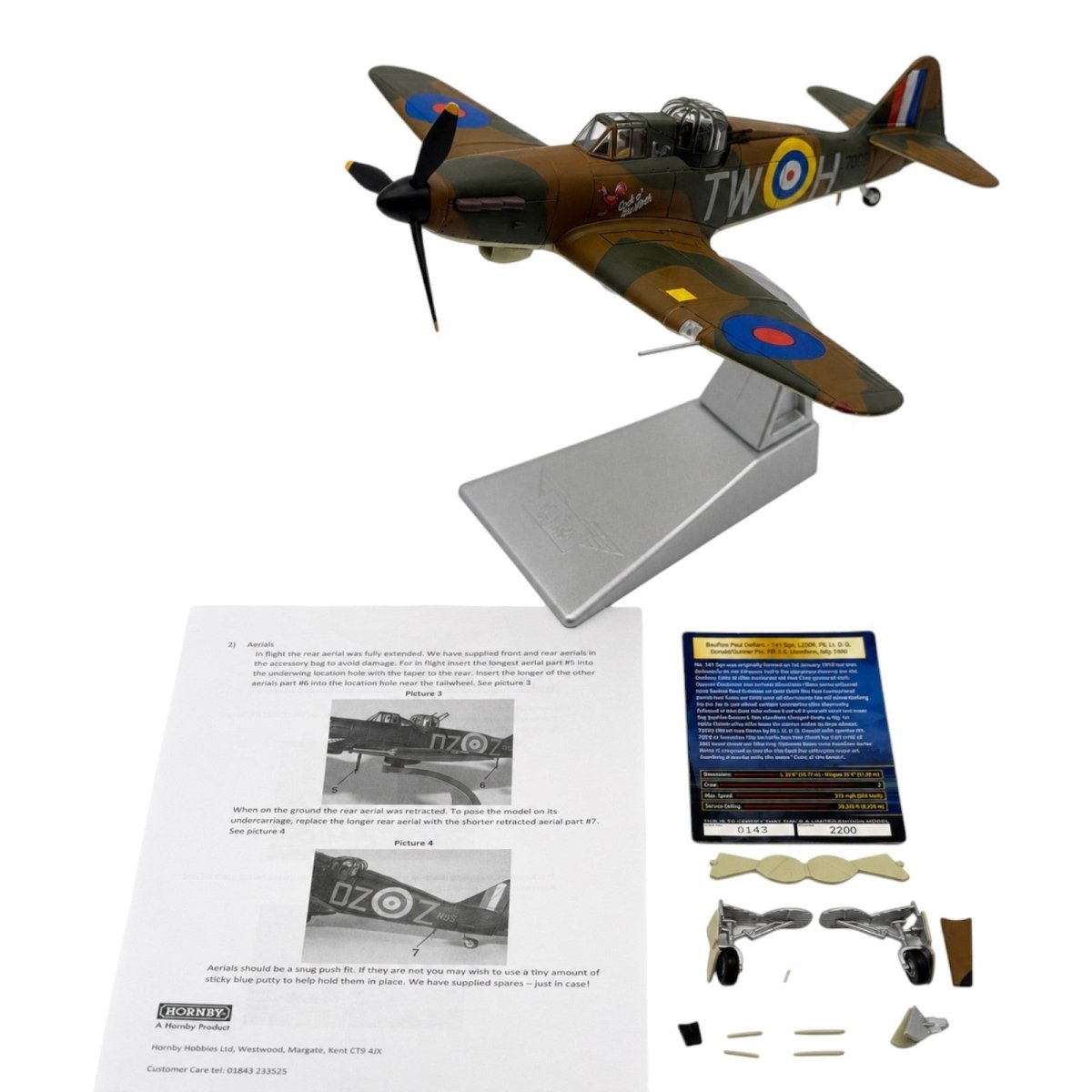
Diecast Aircraft Display Size Guide: Will 1:72, 1:48 or 1:144 Fit Your Cabinet?
Choosing between 1:144, 1:72, 1:48 and 1:32 scale is not simply a question of which number is largest. The dimensions of the real aircraft determine the final footprint, which means a 1:72 Lancaster occupies far more space than a 1:72 Spitfire even though both models use the same scale.
This guide is designed to help collectors estimate the size of a diecast aircraft before buying it, compare familiar aircraft across several scales and check whether a model is likely to fit a shelf or display cabinet.
Quick answer
The scale ratio alone does not give a model's dimensions. Divide the real aircraft's wingspan and length by the scale number, then allow additional room for the stand, undercarriage, weapons, antennas and comfortable clearance around the model.
What Does Aircraft Model Scale Mean?
A scale ratio describes how much smaller a model is than the full-size aircraft:
- 1:144 scale means that one unit on the model represents 144 of the same units on the real aircraft.
- 1:72 scale means that the model is one seventy-second of the aircraft's full dimensions.
- 1:48 scale produces a larger model of the same aircraft than 1:72.
- 1:32 scale produces a larger model again and is normally treated as a substantial display piece.
A lower scale denominator therefore produces the larger model. For the same aircraft, a 1:48 example is one and a half times the length and wingspan of a 1:72 example.
Quick Scale Comparison
| Scale | Practical Display Character | Often Suited To |
|---|---|---|
| 1:144 | Compact and easier to group together. | Bombers, transports and collectors with limited cabinet space. |
| 1:72 | A balance between detail, presence and manageable size. | Fighters, jets and mixed military-aircraft collections. |
| 1:48 | Greater visual presence and a noticeably larger footprint. | Fighters, biplanes and prominent individual displays. |
| 1:32 | Large centrepiece scale requiring dedicated space. | Selected fighters and collectors prioritising maximum display impact. |
How to Calculate the Size of a Scale Aircraft Model
The calculation is straightforward:
Model dimension = full-size aircraft dimension ÷ scale denominator
Keep both figures in the same unit while calculating. If the real aircraft measurement is in metres, the result will initially be in metres and can then be multiplied by 100 to convert it into centimetres.
Example: A 1:72 Avro Lancaster
The Lancaster has an approximate full-size wingspan of 31.09 metres.[3]
- 31.09 metres ÷ 72 = 0.4318 metres.
- 0.4318 metres × 100 = 43.18 centimetres.
- The estimated 1:72 model wingspan is therefore approximately 43.2 cm (17 inches).
This calculates the scale airframe, not the complete display footprint. A stand base, projecting aerial, open canopy or removable weapons may require additional room.
Real Aircraft Size Comparison Across Popular Scales
The following estimates use published dimensions for four familiar aircraft. Figures are shown as approximate wingspan × length and have been rounded to the nearest 0.1 cm. They are intended for display planning rather than as guaranteed measurements for a particular manufacturer's tooling.
| Aircraft | 1:144 Estimate | 1:72 Estimate | 1:48 Estimate | 1:32 Estimate |
|---|---|---|---|---|
| Spitfire Mk Vc[1] | 7.8 × 6.3 cm (3.1 × 2.5 in) |
15.6 × 12.7 cm (6.1 × 5.0 in) |
23.4 × 19.0 cm (9.2 × 7.5 in) |
35.1 × 28.5 cm (13.8 × 11.2 in) |
| Tornado GR1, wings spread[2] | 9.7 × 11.6 cm (3.8 × 4.6 in) |
19.3 × 23.2 cm (7.6 × 9.1 in) |
29.0 × 34.8 cm (11.4 × 13.7 in) |
43.4 × 52.2 cm (17.1 × 20.5 in) |
| Avro Lancaster[3] | 21.6 × 14.7 cm (8.5 × 5.8 in) |
43.2 × 29.4 cm (17.0 × 11.6 in) |
64.8 × 44.1 cm (25.5 × 17.4 in) |
97.2 × 66.2 cm (38.3 × 26.1 in) |
| Avro Vulcan B2[4] | 23.6 × 22.2 cm (9.3 × 8.7 in) |
47.2 × 44.4 cm (18.6 × 17.5 in) |
70.8 × 66.7 cm (27.9 × 26.2 in) |
106.3 × 100.0 cm (41.8 × 39.4 in) |
Important: not every aircraft is commercially available in every scale shown. The table illustrates how the same real aircraft would translate mathematically across the four ratios.

Why Aircraft in the Same Scale Can Be Very Different Sizes
Scale preserves the proportions of the full-size subject; it does not make every model a standard size. A single-engined fighter, a twin-seat strike aircraft and a four-engined bomber can all be labelled 1:72 while requiring very different amounts of space.
The contrast between the Spitfire and Lancaster is particularly useful:
- A 1:72 Spitfire has an estimated wingspan of about 15.6 cm.
- A 1:72 Lancaster has an estimated wingspan of about 43.2 cm.
- The Lancaster therefore requires almost three times the shelf width despite sharing the same scale.
This is why choosing a scale first does not remove the need to check the dimensions of each model individually.
How to Check Whether a Model Will Fit Your Display Cabinet

1. Measure the Usable Interior
Measure the internal width, depth and height of the shelf rather than the cabinet's external dimensions. Frames, hinges, lighting and door mechanisms can reduce the usable space.
2. Measure the Door Opening
A model may fit inside the cabinet but still be too wide or awkward to pass through the opening safely. This is particularly important for large bombers with fixed wings.
3. Confirm the Display Configuration
Check whether the model will be displayed:
- On its undercarriage or on a stand.
- With the canopy open or closed.
- With wings spread, swept or folded.
- With weapons, fuel tanks or other accessories fitted.
4. Include the Stand and Base
The calculated aircraft dimensions do not include a stand. A stand can increase the required depth, raise the tail or wingtips and change the angle at which the model occupies the shelf.
5. Allow Comfortable Clearance
Avoid planning for an exact wingtip-to-glass fit. Leaving several centimetres around the model makes it safer to position, dust and remove without catching antennas, pitot tubes, propellers or other delicate parts.
Variable-Sweep Wings and Other Changing Dimensions
Aircraft such as the Tornado can occupy very different widths depending on the wing position. The full-size Tornado GR1 had a wingspan of approximately 13.9 metres with the wings spread and about 8.6 metres at maximum sweep.[2]
At 1:72 scale, this equates to approximately:
- 19.3 cm across with the wings spread.
- 11.9 cm across at maximum sweep.
The exact options depend on the individual model. Some diecast releases have movable wings, while others are fixed in one position. Similar considerations apply to folded naval-aircraft wings, extended refuelling probes and open airbrakes.
Which Scale Works Best for Your Available Space?
Limited Shelf or Cabinet Space
1:144 can be particularly practical for bombers and transports. It allows a large aircraft type to retain its recognisable shape without dominating an entire shelf.
A Mixed Collection of Fighters and Jets
1:72 normally provides a useful balance of presence and capacity. Smaller fighters remain compact, although large bombers and delta-wing aircraft can still become substantial display pieces.
A Smaller Number of High-Impact Models
1:48 and 1:32 suit collectors who prefer larger individual displays. These scales make smaller surface details easier to appreciate, but the increase in footprint is significant and should be calculated before purchase.
Common Display-Planning Mistakes
- Assuming every model in one scale is a similar size.
- Using the cabinet's external measurements instead of the usable interior.
- Forgetting to check whether the model can pass through the door opening.
- Ignoring the stand, weapons, antennas or open canopy.
- Relying on the packaging dimensions as the aircraft's display footprint.
- Positioning delicate wingtips or probes directly against glass or another model.
Shop Diecast Aircraft by Scale
Explore the current aircraft available in the scales covered by this guide:
- Corgi Aviation Archive 1:72 aircraft
- Hobby Master 1:72 aircraft
- Corgi Aviation Archive 1:48 aircraft
- Hobby Master 1:48 aircraft
- Corgi Aviation 1:144 aircraft
- Corgi Aviation Archive 1:32 aircraft
Browse all diecast aircraft models.
Frequently Asked Questions
Is 1:48 scale bigger than 1:72?
Yes. When comparing the same aircraft, a 1:48 model is one and a half times its 1:72 equivalent in both length and wingspan.
How big is a 1:72 aircraft model?
There is no single standard size. A 1:72 Spitfire is approximately 15.6 cm across, while a 1:72 Lancaster is approximately 43.2 cm across. The full-size aircraft dimensions determine the model's footprint.
How do I calculate 1:72 scale in centimetres?
Convert the real measurement to centimetres and divide it by 72. For example, a 1,123 cm wingspan becomes approximately 15.6 cm at 1:72 scale.
Does a display stand change the space required?
Often, yes. The base and display angle can increase the required shelf depth or height even when the aircraft itself fits comfortably.
Which scale is best for large bombers?
1:144 is often the more manageable choice when space is limited, while 1:72 bombers provide far greater presence but can require a wide and deep shelf. Always calculate the dimensions of the particular aircraft.
Related Collector Guides
- A Beginner’s Guide to Collecting Diecast Aircraft Models
- The History of Corgi Aviation Archive Scale Sizes
- How to Care for Diecast Aircraft Models: Cleaning, Storage & Display
- Return to the Collector Guides & Articles hub
Sources & Further Reading
- National Museum of the United States Air Force – Supermarine Spitfire Mk Vc
- National Museum of the United States Air Force – Panavia Tornado GR1
- Lancaster Archive – Lancaster Dimensions, Weights and Air Speeds
- Royal Air Force Museum – Avro Vulcan B2
Measurement note: aircraft dimensions can vary between marks and configurations. Calculated model sizes are proportional estimates and may differ slightly from a finished diecast release because of tooling choices, removable components and projecting details. Check the measurements supplied on the individual product page whenever available.

Written by Jay Sawyer