Limited-Edition Diecast Aircraft Explained: Production Runs, Certificates & Numbering
The words “limited edition” appear frequently in the diecast aircraft market, but they do not always mean the same thing.
Some models are supplied with individually numbered certificates, while others are limited only by the number manufactured. Certain releases may have a stated production quantity without each model receiving its own edition number, and some models described as limited editions may still have been produced in relatively large numbers.
Understanding the difference between a production run, certificate and individual edition number can help collectors identify what should be included with a model and judge how meaningful its limited-edition status really is.
For wider advice about availability and collectability, you may also find our guide to spotting rare diecast aircraft models and our diecast aircraft identification and value guide useful.
What Is a Limited-Edition Diecast Aircraft Model?
A limited-edition model is produced in a restricted quantity rather than remaining in continuous production indefinitely.
Once that production run has been completed, the manufacturer may not produce exactly the same release again. The aircraft casting might be reused, but the specific combination of markings, serial number, squadron, pilot and historical setting will usually remain connected to that particular product code.
A limited edition may be identified through:
- A stated production quantity
- An individually numbered certificate
- A number printed on the model or packaging
- Manufacturer catalogues or release information
- Contemporary dealer announcements
- Collector reference books or databases
However, the absence of a numbered certificate does not automatically mean that a model was produced without a limited production run.
Production Run and Edition Number Are Not the Same
The production run is the total number of examples manufactured or allocated for a particular release.
For example, a model may have a stated production run of 1,300 pieces.
An individual edition number identifies one numbered example within that run. A certificate marked:
0207 of 1300
indicates that the certificate relates to individual example number 207 from a total stated production run of 1,300 models.
The two numbers serve different purposes:
- 0207 is the individual edition number
- 1300 is the total production quantity stated on the certificate
The individual edition number does not normally reveal where the model was sold, when it left the factory or whether it was physically the 207th example to be manufactured. It is primarily a numbering system used to distinguish one certificate from another.
Are All Limited Editions Individually Numbered?
No. A model can be limited by its production quantity without being individually numbered.
This is particularly important when comparing manufacturers because each brand approaches production runs, certificates and packaging differently.
A model may be limited because the manufacturer produced only one finite batch, even though:
- No numbered certificate was supplied
- No edition number appears on the model
- The total production quantity was not printed on the box
- The exact quantity was only mentioned in trade or catalogue information
Collectors should therefore avoid assuming that a model is unlimited simply because there is no certificate card inside the packaging.
Hobby Master Production Runs and Certificates
The majority of Hobby Master aircraft are technically limited by their individual production runs, but they do not normally include an individually numbered certificate card.
A particular Hobby Master release is generally produced as a finite batch representing one aircraft, operator, serial number, squadron or colour scheme. Once that batch has sold through, the exact release may become difficult to find even though no numbered certificate was originally supplied.
Hobby Master packaging will normally provide information such as:
- Product code
- Aircraft type and variant
- Scale
- Operator
- Squadron or unit
- Aircraft serial number
- Pilot or crew connection
- Historical date or location
The product code is particularly important. A reference such as HA3871 identifies the exact release and allows it to be distinguished from other Hobby Master models using the same aircraft tooling.
The absence of a certificate does not make a Hobby Master aircraft incomplete, provided that the release was not originally supplied with one.

Although most Hobby Master aircraft do not include a certificate, selected releases were supplied with individually numbered cards. This HA7107 example is numbered 0580 from a stated production run of 1,000 models.
Corgi Aviation Archive Certificates
Many Corgi Aviation Archive models were supplied with a certificate card, particularly releases marketed as individually numbered limited editions.
A Corgi certificate may show:
- The individual edition number
- The stated total production run
- The aircraft type and variant
- Pilot or crew details
- Squadron or military unit
- Aircraft serial number
- Historical background
- A description of the event represented
- Artwork or photography connected to the aircraft
These cards are more than simple proof of numbering. They often tell the story behind the model and explain why that particular aircraft, pilot, squadron or historical moment was chosen for release.

The reverse of the certificate tells the historical story behind the aircraft and records its individual edition number. This example is numbered 0067 from a stated production run of 1,000 models.
For collectors, the certificate can therefore serve three purposes:
- It confirms the stated edition number
- It forms part of the model’s original contents
- It provides historical context for the aircraft represented
This storytelling element is one reason Corgi certificate cards remain appealing even when the individual number itself has little effect on the model’s value.

The front of a Corgi Aviation Archive collector card can identify the exact release through its product code, aircraft artwork and stated production quantity, forming part of the model’s original presentation.
Certificates From Other Diecast Aircraft Brands
Certificates and collector cards are not exclusive to Corgi Aviation Archive. Selected releases from other manufacturers, including Gemini, JC Wings and Century Wings, may also include a numbered certificate, collector card or certificate of authenticity.
The format and purpose of these certificates can vary considerably between brands and individual releases. Some cards simply confirm the individual edition number and total production quantity, while others may include aircraft information, signatures, special-edition details or additional historical background.
Examples can include:
- Gemini Aces limited-edition aircraft supplied with numbered collector certificates
- JC Wings special or limited releases supplied with certificates of authenticity
- Century Wings limited and signature editions supplied with numbered or signed certificate cards
This does not mean that every model produced by these manufacturers originally included a certificate. The contents can vary by range, scale, production period and exact product code.
Collectors should therefore research the specific release rather than assuming that a certificate is missing simply because another model from the same brand included one.
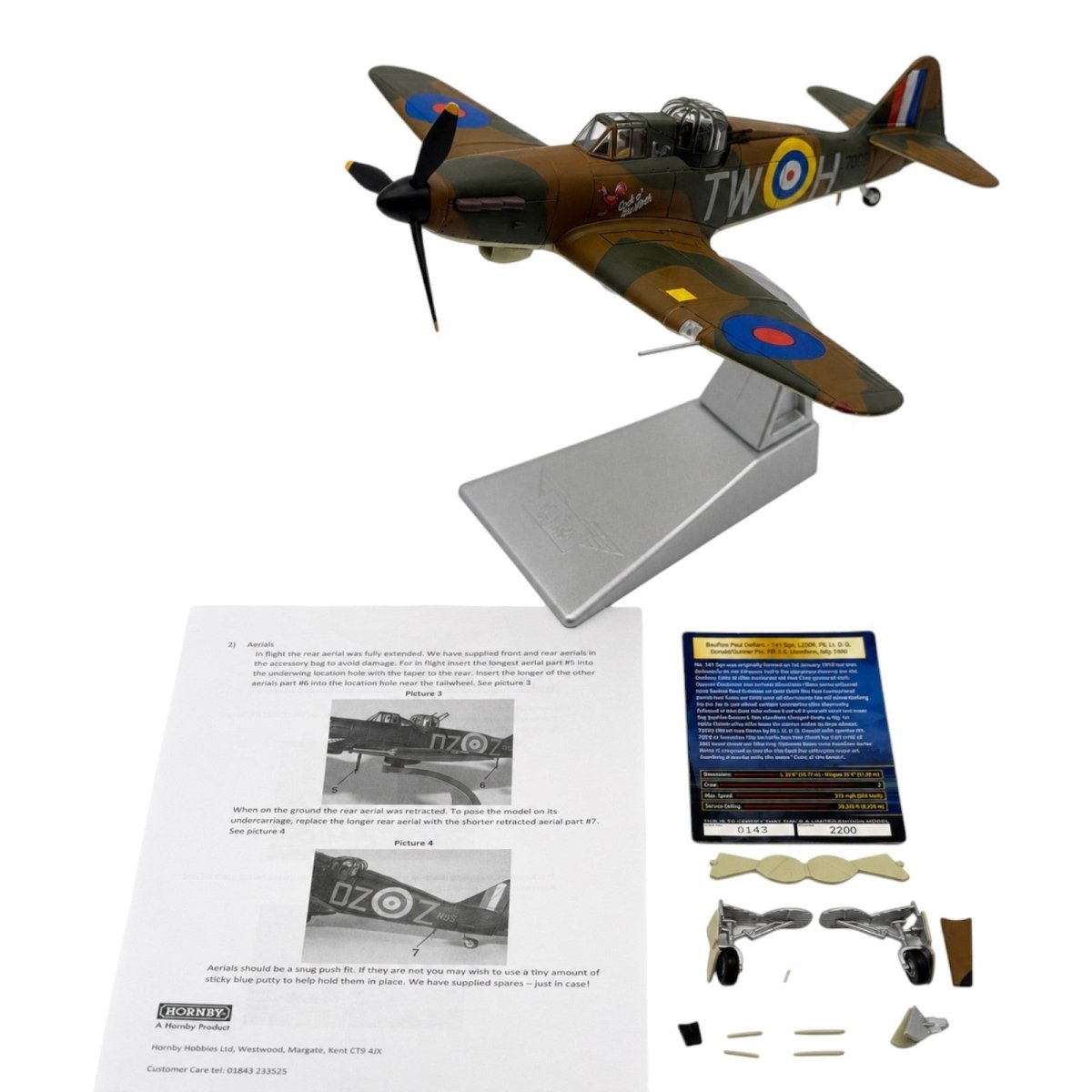
Where a certificate was originally supplied, it should be considered part of the complete set alongside the model, box, stand, accessories and instructions. Where a release was never supplied with a certificate, its absence does not make the model incomplete.
You can learn more about these manufacturers in our guide to other diecast aircraft brands, including Century Wings, Gemini and JC Wings.
What Does “De-Certificated” Mean?
Some Corgi models are described as de-certificated. This does not necessarily mean that a previous owner lost the certificate.
In many cases, models appear to have been deliberately de-certificated before being distributed or sold. This was commonly associated with remaining stock from an individually numbered release that had not sold through as expected.
The numbered certificate could be withdrawn or withheld, with the packaging marked to show that the model was being sold as a de-certificated example rather than as an individually certified limited edition.
The aircraft itself would generally remain the same model, with the same product code, markings, paint scheme and accessories. The principal difference was that the de-certificated example did not include the individually numbered certificate associated with the original certified release.
The precise reason may vary between releases. De-certification may have been connected to:
- Remaining unsold stock
- A release selling more slowly than expected
- A later quantity being distributed without numbered certificates
- Changes to how the remaining models were marketed
Collectors should therefore research the exact product code rather than assuming that every de-certificated Corgi model has the same background.
How Can a Factory De-Certificated Model Be Identified?
A genuine factory de-certificated example may be identified by:
- A de-certificated label applied to the box
- Wording stating that no limited-edition certificate is included
- A product reference that may carry an additional letter or suffix
- Contemporary retailer or catalogue descriptions
A genuine de-certificated model should not automatically be treated as incomplete because it was intentionally distributed without an individually numbered certificate.
This is different from a certified model whose original certificate has subsequently been lost. In that situation, part of the model’s original contents is missing.
Collectors should distinguish between:
- A model officially de-certificated before sale
- A release that was never intended to include a certificate
- A certified model whose certificate has been lost
- A certificate that has become separated from the correct aircraft
- A model paired with a certificate belonging to another example
Where present, the de-certificated label forms part of the model’s release history and should generally be left attached to the packaging. Removing it could make it harder for a future collector to understand why no numbered certificate is included.

This Corgi box carries a factory-applied de-certificated label stating that the certificate is not included and that the label should not be removed. This confirms that the absence of a certificate was intentional, rather than the result of one being lost by a previous owner.
Does a Missing Certificate Affect Value?
A missing certificate may affect value when the model was originally supplied with one.
The extent of the effect will depend on:
- The rarity of the model
- The condition of the aircraft
- The condition of the box
- Whether all other accessories are present
- How strongly collectors value completeness
- Whether the certificate contains important historical information
- How difficult complete examples are to find
A rare model may remain highly desirable without its certificate, particularly when the aircraft and packaging are otherwise in excellent condition.
However, a complete example with its original certificate will normally appeal more strongly to collectors than an otherwise identical certified model missing part of its original contents.
The certificate should therefore be considered alongside the box, display stand, instructions, undercarriage, weapons, paperwork and other removable accessories rather than treated as the only factor determining completeness.
For more advice on how completeness affects collectability, see our diecast aircraft model identification and value guide.
Does a Low Edition Number Make a Model More Valuable?
A low edition number can be attractive, but it does not normally create a substantial increase in value by itself.
For example, certificate number 0025 may appear more desirable than certificate number 1184, but both belong to the same production run and represent the same aircraft release.
Some collectors may personally prefer:
- Very low numbers
- Round numbers
- Repeating numbers
- The first or final number in a run
- A number connected to the aircraft’s serial or squadron
However, these preferences are highly individual.
The model’s overall desirability will usually depend far more on:
- The aircraft represented
- The pilot or squadron
- Historical significance
- Model condition
- Completeness
- Packaging condition
- Current availability
- Collector demand
A low certificate number does not make a common or less popular release genuinely rare.
Does a Certificate Prove the Model Is Rare?
Not necessarily.
A numbered certificate confirms that the model formed part of a stated production run, but it does not prove that the release is valuable or difficult to find.
A release of 5,000 models may be limited in a technical sense, but that is still a substantial number of examples. If collector demand is modest, the model may remain readily available for many years.
A smaller production run may also remain relatively inexpensive when few collectors are actively looking for that particular aircraft or scheme.
The strongest values usually occur when several factors come together:
- A genuinely restricted supply
- Strong collector demand
- A popular aircraft, pilot or squadron
- Historical importance
- Attractive or unusual markings
- Good model condition
- Complete original packaging and accessories
Limited production is only one part of the wider picture. Our guide to identifying rare diecast aircraft models explains the relationship between scarcity, availability and demand in greater detail.
Can the Same Aircraft Be Released More Than Once?
Manufacturers frequently reuse the same aircraft tooling for multiple releases.
For example, several models may represent the same aircraft type and scale while differing in:
- Squadron markings
- Aircraft serial number
- Pilot
- Operator
- Weapons configuration
- Historical date
- Camouflage scheme
- Commemorative livery
Each release may have its own product code and individual production run.
A later release using the same aircraft casting does not necessarily reduce the collectability of an earlier model because many collectors are interested in the individual aircraft, markings and historical subject rather than the tooling alone.
However, an exact aircraft or colour scheme may occasionally be revisited or reissued. Collectors should compare product codes, box descriptions, markings and accessories carefully to determine whether two models are genuinely the same release.
How to Check Whether a Certificate Matches the Model
Certificates can become separated from their original models, particularly when large collections have been moved, displayed or reorganised.
To check whether a certificate belongs with a model, compare:
- Manufacturer
- Product code
- Aircraft type
- Aircraft variant
- Pilot or crew
- Squadron
- Aircraft serial number
- Historical description
- Production quantity
- Box artwork and description
A certificate that describes the correct aircraft type but a different pilot, serial number or squadron may belong to another release using the same basic casting.
The edition number alone cannot confirm that the certificate and model originally left the factory together. The aircraft and historical details should also correspond.
How to Check a Production Quantity
Production figures may be found on:
- Certificate cards
- Box labels
- Manufacturer catalogues
- Archived manufacturer pages
- Dealer release sheets
- Collector reference books
- Specialist databases
Figures repeated in marketplace listings should be treated cautiously unless they can be traced to a dependable original source.
Sellers sometimes copy information from other listings, allowing an incorrect production figure to be repeated across several websites.
Where no reliable quantity can be confirmed, it is better to say that the model was produced as a finite release than to claim a precise number without supporting evidence.
Limited Edition Does Not Always Mean Scarce Today
A model’s original production quantity does not tell you how many examples remain available in good and complete condition.
Over time, models may become:
- Damaged
- Incomplete
- Separated from their original boxes
- Lost from collections
- Repaired or modified
- Affected by paint or metal deterioration
- Separated from their certificates and accessories
A release originally produced in a relatively large quantity may therefore become difficult to find complete.
Conversely, a model with a low stated production run may remain easy to purchase if many collectors kept their examples boxed and later placed them back onto the market.
Current availability and demand matter just as much as the original quantity produced.
You can explore our previously sold models archive to see examples of older and discontinued releases that have passed through The Collectables Vault.
What Should Collectors Look For?
When assessing a limited-edition diecast aircraft model, record the following:
- Manufacturer
- Product code
- Aircraft and variant
- Scale
- Stated production quantity
- Individual edition number, where applicable
- Whether a certificate was originally supplied
- Whether the certificate matches the model
- Whether the model was officially de-certificated
- Model condition
- Box condition
- Included accessories and paperwork
- Current availability and recent sold prices
This helps separate meaningful information about the release from general limited-edition marketing language printed on the packaging.
Model and box condition should also be assessed separately. Our diecast aircraft grading guide explains the main factors to inspect.
Final Thoughts
Limited-edition diecast aircraft models are not all presented in the same way.
Many Hobby Master aircraft are limited by their finite production runs but do not include individually numbered certificate cards. Corgi Aviation Archive releases are more commonly associated with certificates, although some remaining Corgi stock was deliberately de-certificated and distributed without a numbered certificate.
Where supplied, Corgi certificates are an important part of the model’s original presentation because they often tell the story of the aircraft, pilot, squadron and historical event represented.
A certificate number can be interesting, but it should not be treated as the main measure of value. Production quantity, condition, completeness, availability and collector demand are usually much more important.
The best approach is to research the exact product code and determine what was originally supplied with that particular release. A missing certificate matters when the model was intended to include one, while a model officially produced or distributed without a certificate should not be regarded as incomplete for that reason.
You can browse our current diecast aircraft model collection, explore Corgi Aviation Archive models and Hobby Master aircraft, or discover more articles through our collector guides and histories.

Written by Jay Sawyer