Article: CORGI AVIATION ARCHIVE: A GUIDE TO THE MODEL LINE, SCALES & KEY FEATURES
CORGI AVIATION ARCHIVE: A GUIDE TO THE MODEL LINE, SCALES & KEY FEATURES

What Is Corgi Aviation Archive?
Aviation Archive is Corgi’s range of ready-made diecast aircraft models. It includes fighters, bombers, helicopters and other aircraft, with many releases representing a particular squadron, pilot or moment in aviation history.
The models arrive painted and assembled, although some have separate accessories to fit before display. Many include a stand and alternative undercarriage parts, giving you a choice of how to display the aircraft.
If you are starting a collection, this guide explains the different scales, what usually comes in the box and what to check when buying an older release.
Looking to explore the range? Browse the Corgi Aviation Archive models currently available from The Collectables Vault.
Scales Used in the Aviation Archive Line
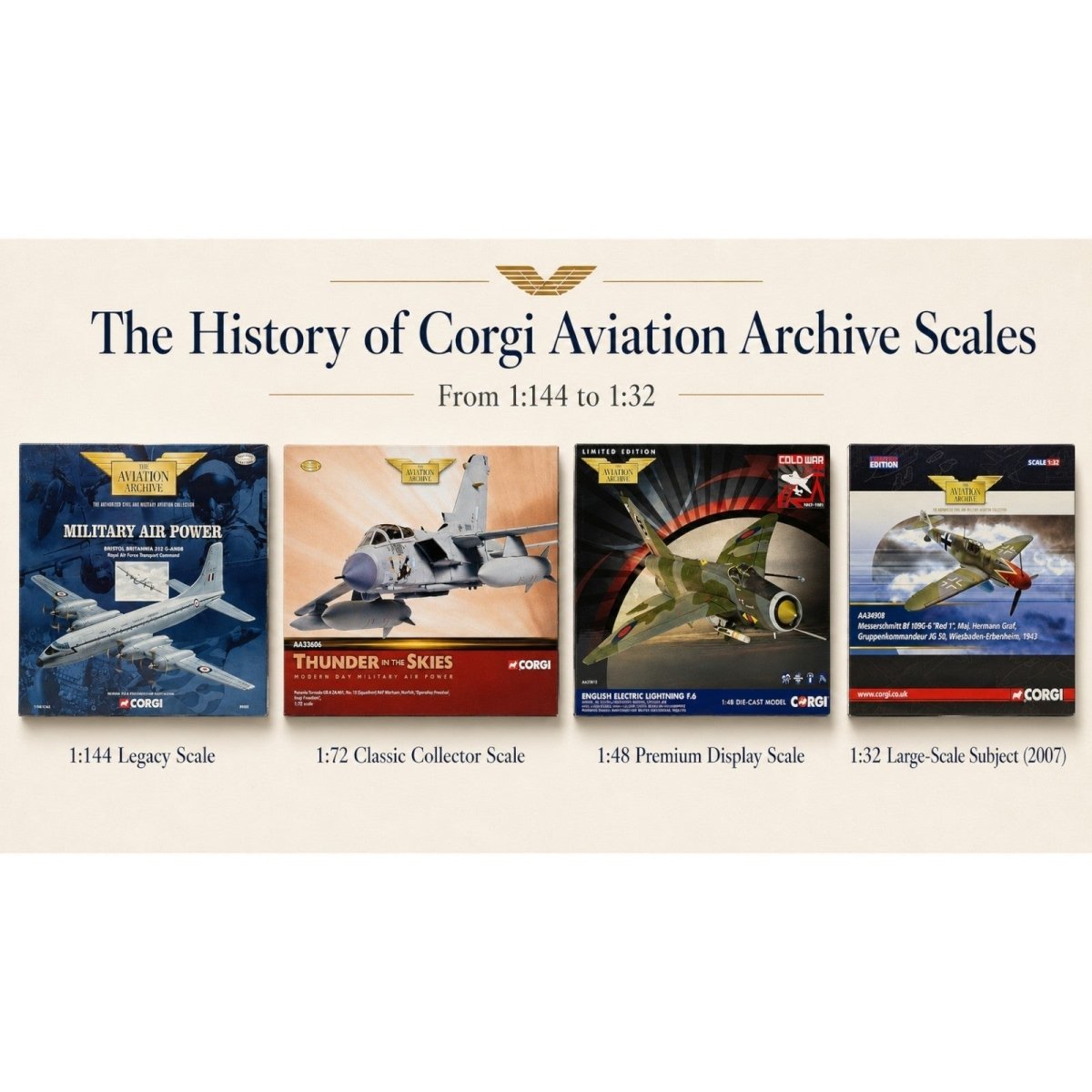
Corgi has used several scales throughout the Aviation Archive range. The most common scales collectors encounter are:
1:72 Scale
- The core scale for much of the Aviation Archive range.
- Ideal for single-engined fighters and many jets, providing strong detail without taking up as much room as larger scales.
- Frequently used for aircraft such as the Spitfire, Hurricane, Bf 109, P-51 Mustang, English Electric Lightning and F-4 Phantom.
- Also used for larger bombers and transport aircraft. These can take up considerably more shelf space than a fighter in the same scale.
1:144 Scale
- Common for larger bombers, transports and civil aircraft where a 1:72 model would require considerable display space.
- Used for subjects including the Lancaster, B-17, B-24, Vulcan, Victor and a variety of airliners.
- A practical option for collectors who want to display several heavy aircraft together.
1:48 Scale
- A larger scale used for selected fighters, biplanes and other prominent releases.
- Makes smaller details easier to see, although the model needs more display space.
1:32 Scale
- Used for some of Corgi’s largest single-engined aircraft models.
- These models are larger and heavier, so check the dimensions and the space available before buying.
When browsing, the scale is normally printed on the box and included in the product description. Display space is worth considering before choosing between a compact 1:144 collection, a broad 1:72 collection or the larger 1:48 and 1:32 centrepieces.
Shop Corgi Aviation by Scale
- Corgi Aviation Archive 1:72 scale aircraft
- Corgi Aviation Archive 1:48 scale aircraft
- Corgi Aviation Archive 1:144 scale aircraft
- Corgi Aviation Archive 1:32 scale aircraft
Typical Features of Corgi Aviation Archive Models
Although the exact specification varies between releases and production eras, most Aviation Archive models share several recognisable features:
- Diecast metal construction with some plastic components used for finer details such as undercarriage, antennas and weapon loads.
- Factory-applied paint and markings, including camouflage schemes, squadron codes, nose art and stencilling.
- A display stand, usually printed with information identifying the aircraft or unit.
- Optional undercarriage configurations on many releases, allowing the model to be displayed in flight or on the ground.
- Alternative accessories on selected models, such as bombs, missiles, drop tanks or closed undercarriage parts.
- Detailed collector packaging, often accompanied by aircraft history, specifications and a certificate of authenticity.
Earlier releases can be simpler than models produced from newer tooling, but many remain highly attractive display pieces and are sought after for their subjects, markings and place within the history of the range.
Understanding Corgi Product Codes and Box Information
Each Aviation Archive release has its own Corgi product code. Most use an AA-prefixed reference, and collectors often use this code as the quickest way to distinguish one particular release and colour scheme from another.
On the box or accompanying paperwork, you will usually find:
- The product code, such as AA36104.
- The aircraft type and variant, such as Spitfire Mk IX, F-86 Sabre or Lancaster B.Mk I.
- The unit and markings, including the squadron, operator and sometimes the pilot, base or year.
- The scale, commonly 1:72, 1:144, 1:48 or 1:32.
- Historical information about the aircraft, unit or mission, which may appear on the box or certificate of authenticity.
When dealers and collectors refer to an AA number, they are normally identifying that exact Corgi release rather than the aircraft type in general. Searching by product code is therefore one of the most effective ways to find a missing model or compare examples.
Limited Editions, Repaints and Reissues
Corgi has produced limited editions, new colour schemes and revised versions of existing aircraft. Understanding the differences can help you identify the release you are looking for.
Limited-Edition Runs
Many Aviation Archive models were produced as limited editions, often with a certificate showing the overall edition size and the individual number assigned to that example.
Production numbers alone do not determine value, but releases depicting famous aircraft, pilots, squadrons or particularly attractive schemes can become difficult to find after selling out.
Repaints and New Tooling
Corgi frequently reuses a basic aircraft tooling for several different schemes. The same Spitfire, Lightning or Phantom mould may therefore appear with numerous squadron markings and operators.
Some collectors specialise in a single aircraft type and try to obtain every scheme produced from that tooling. Corgi has also introduced new tooling over time, often bringing improved detail or revised shapes to familiar subjects.
Reissues and Related Schemes
Corgi occasionally revisits a subject through a related scheme, anniversary release or updated set of markings. These are not necessarily identical reissues, but they can provide another opportunity to collect a favourite aircraft or unit.
Themes and Eras Covered by Aviation Archive
The range is broad enough to represent most major periods of military aviation. Popular collecting themes include:
Second World War
- RAF fighters such as the Spitfire, Hurricane and Typhoon.
- USAAF aircraft including the P-51, P-47, B-17 and B-24.
- Luftwaffe and Axis types such as the Bf 109, Fw 190 and Ju 88.
- RAF Bomber Command, Coastal Command and Fleet Air Arm subjects.
Cold War and Early Jet Age
- English Electric Lightning, Gloster Meteor and Hawker Hunter.
- Sabres, MiGs and other aircraft operated by NATO and Warsaw Pact air forces.
- Early jet bombers, reconnaissance aircraft and training types.
Modern Jets and Attack Aircraft
- Tornado, Harrier and Jaguar.
- F-4 Phantom, F-14, F-16, F/A-18, Mirage and MiG-29.
- Special schemes, display teams and anniversary liveries.
Bombers and Heavy Aircraft
- Lancaster, Halifax and Wellington.
- Vulcan, Victor and Valiant.
- Transport, maritime patrol and tanker aircraft.
This variety allows collectors to build a display around a particular squadron, air base, aircraft type, operator, conflict or period in aviation history.
Condition, Boxes and Display
For many Aviation Archive collectors, condition is almost as important as the subject. When buying a model, it is worth checking both the aircraft and everything originally supplied with it.
Model Condition
- Paint: chips, scratches, bubbling or discolouration.
- Markings: cracks, lifting, silvering or yellowing.
- Parts: missing pitot tubes, antennas, weapon pylons or undercarriage components.
- Repairs: glued parts, repainting or previous modifications.
A model with minor issues can still make an attractive and desirable display piece, particularly when the release is scarce, but faults should be clearly described before purchase.
Box and Packaging
Collectors may also consider:
- The condition of the outer box, including crushing, creasing, edge wear and old price stickers.
- The presence and condition of the inner tray, protective inserts and fixing materials.
- Certificates, instruction sheets, leaflets, stands and accessory packets.
A complete model with its original packaging is normally easier to store safely and can be more desirable than a loose example.
Display and Storage
- Avoid direct sunlight to reduce the risk of fading or discolouration.
- Keep dust away from the model, stand and smaller accessories.
- Handle the aircraft by stronger parts of the airframe rather than antennas, weapons or undercarriage.
- When storing the model, use the original tray and protective packaging where possible.
For further advice, read our guide to common diecast aircraft model problems and repairs.
Why Collectors Love Corgi Aviation Archive
Aviation Archive has remained popular for several reasons:
- Brand recognition: Corgi is a long-established name with a strong following among diecast collectors.
- Depth of subjects: the range covers aircraft from the First World War through to modern frontline types.
- Appearance: the aircraft’s shape, markings and size can make it an appealing addition to a display.
- Historical connection: many releases commemorate real aircraft, pilots, units and missions.
- Ready-made presentation: collectors can enjoy a detailed aircraft model without needing to assemble or paint it.
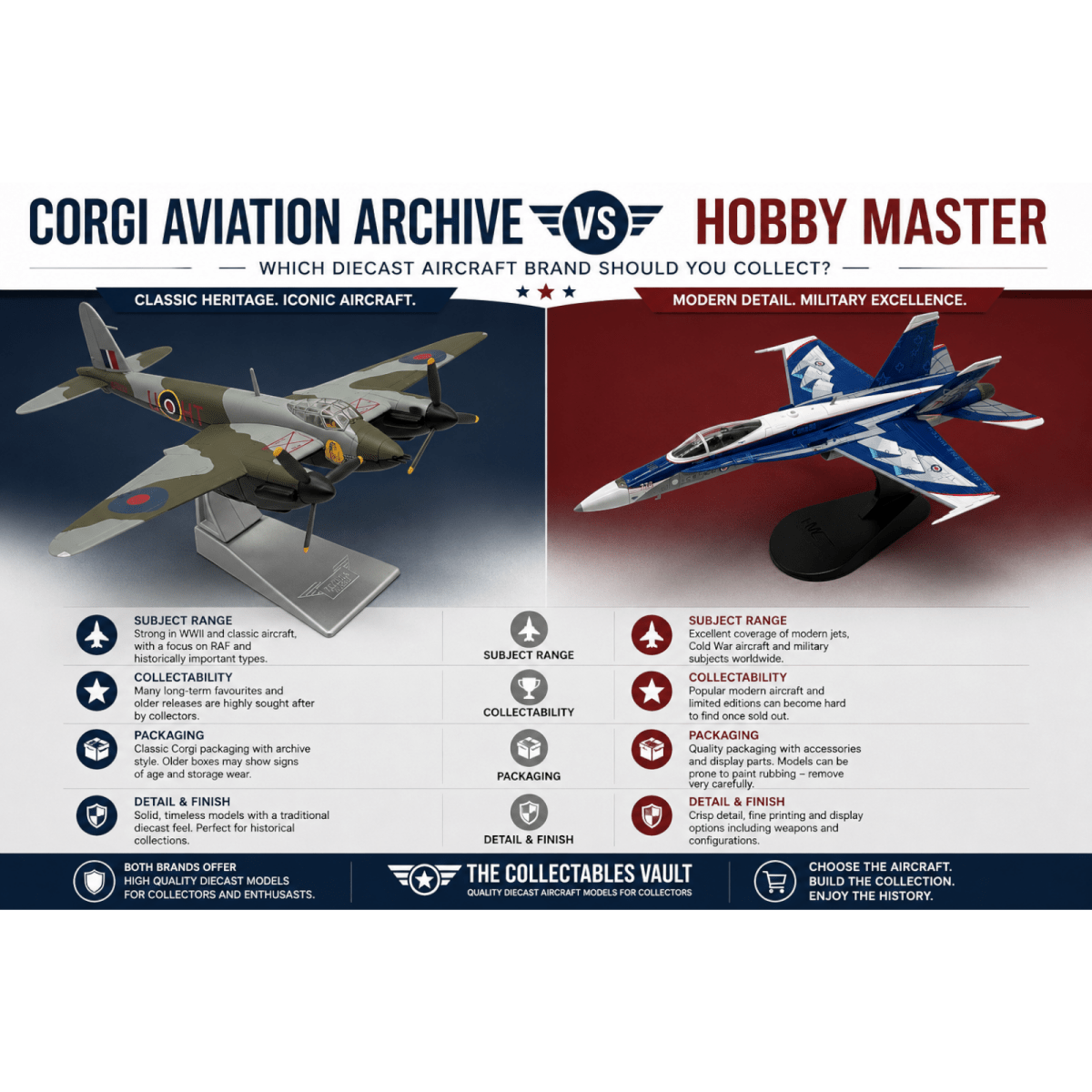
For a closer comparison with another leading diecast aircraft brand, see our guide to Corgi Aviation Archive versus Hobby Master.
Building Your Own Corgi Aviation Archive Collection
There is no single correct way to collect Aviation Archive. A collection could be built around:
- A particular squadron, air base or operator.
- A favourite aircraft type represented through several units and periods.
- Aircraft associated with a local airfield or national air force.
- A single scale, such as 1:72 fighters or 1:144 heavy aircraft.
- A campaign or era, including the Battle of Britain, Bomber Command or the Cold War.
- A combination of Corgi and other diecast brands that complement one another.
If value is an important consideration, our guide explaining how much a diecast aircraft model may be worth covers rarity, condition, completeness and collector demand in more detail.
Frequently Asked Questions
Are Corgi Aviation Archive models still being produced?
Yes. Corgi continues to release Aviation Archive models alongside occasional new schemes and revisited subjects. Many older releases are retired and can now only be found through the secondary market.
What scales are Corgi Aviation Archive models made in?
The most frequently encountered scales are 1:72 and 1:144, although Corgi has also produced selected aircraft in 1:48 and 1:32. Check the dimensions of the particular model, as aircraft in the same scale can still differ considerably in size.
Are Corgi Aviation Archive models metal or plastic?
They are primarily made from diecast metal, with plastic used for finer components such as undercarriage, antennas, cockpit parts and weapon loads.
Do Aviation Archive models include stands and accessories?
Most releases include a display stand, while many also provide optional undercarriage or weapon configurations. Contents vary by model, so the individual listing should always be checked for completeness.
Are lower certificate numbers more valuable?
A low certificate number can add interest for some collectors, but rarity, model condition, box condition, completeness and demand for the particular aircraft or scheme usually have a greater influence on value.
Are Corgi Aviation Archive models suitable as toys?
No. Aviation Archive models are collector display pieces, typically recommended for ages 14 and over. They contain small and delicate parts that are not designed for rough play.
Continue Exploring
Shop Corgi Aviation Archive
Explore More Models
Related Collector Guides

Written by Jay Sawyer